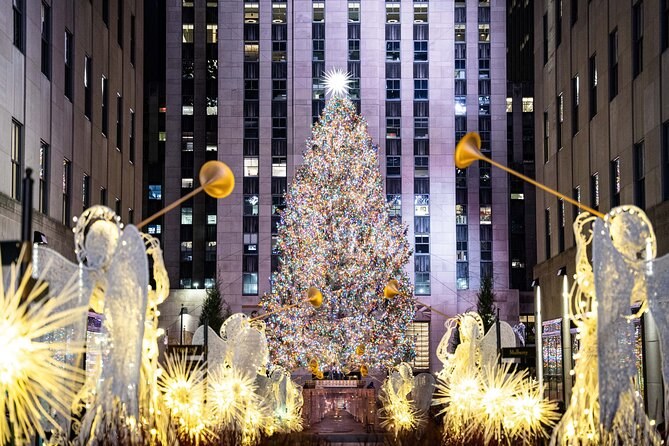
NYC Holiday Lights and Dyker Heights Luxury Bus Tour
Licensed guideHeated vehicleCoach travel
From $75 per person
Most of what circulates about these streets is either wrong or unsourced. Here are twelve things that are documented, and several of them will change how the evening looks.
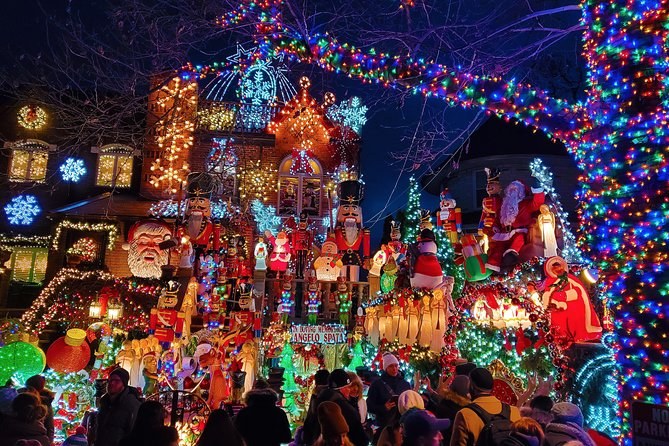
Lucy Spata decorated her home on 84th Street after her parents died, in memory of a mother who had loved Christmas. Everything on these blocks descends from that. The angels she still puts up each year are for her mother.
The first objection was not the taste. It was the traffic. That tells you how quickly it grew from one house to a destination, and it is more or less the same complaint the neighbourhood negotiates today.
"When you go pay my mortgage, then I'll stop," Spata told a Brooklyn paper in 2023. She has also said she thought of the people who could not get to Rockefeller Center, which is the part of the story most retellings leave out.
"It's never been a competition kind of a thing," one told a Brooklyn magazine, and residents who do not decorate report no pressure to start. The rivalry is something visitors bring with them.
Firms including B&R, run by James Bonavita, and DiMeglio Decorators put them up and take them down. This is a trade with a season, not a weekend of ladders.
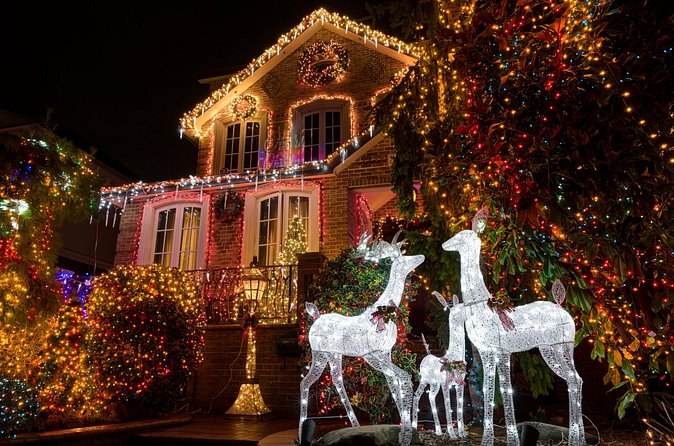
Estimates from within the neighbourhood put a professionally decorated house at $3,000 to $10,000 or more for a season, depending on its size. That is the installation, not the electricity.
Six numbers that are actually sourced. Most of the figures circulating online are not.
| Figure | What it is | Where it comes from |
|---|---|---|
| 1986 | The year Lucy Spata's display went up | Brooklyn press and BKMAG |
| 1899 | The year the Saitta House was built | Its National Register listing |
| 30 May 2007 | The date the Saitta House was listed | National Register |
| $3,000–$10,000+ | A professionally decorated house, per season | Decorators quoted by BKMAG |
| 100,000+ | Visitors a season, and probably more | Brooklyn Paper |
| 1895 | The year the neighbourhood was laid out | Neighbourhood history |
Everything is LED now, on timers. One resident's summary of the running cost: "it's no more expensive than running the air conditioner all summer long." The cost is the installation, not the current.
1135 84th Street is the Saitta House, a two-and-a-half-storey Queen Anne built in 1899 by the architect John J. Petit for Beatrice and Simone Saitta. The land cost $2,700 and the house cost $14,000. It joined the National Register on 30 May 2007.
The listing followed a New York University medical student writing his college thesis on the neighbourhood's under-appreciated history. A hundred thousand people a year now walk past it without looking up.
Walter Loveridge Johnson began developing the hill in October 1895, between Tenth and Thirteenth Avenues from 79th to 86th Street. Large plots, detached houses, deep front gardens and long facades — which is, as it turns out, a canvas. A terrace of brownstones could not do this. The history page has the rest.
Dyker Heights takes its name from the Dyker Meadow and Beach the development overlooked, and the dykes that drained the meadow. It is traced to the Van Dykes, an original New Utrecht family. A very ordinary origin for the brightest street in New York.
Plenty of pages describe a Dyker Heights holiday market. There is not one and there has never been one. What exists is residents selling hot chocolate from their driveways, and several tours that finish at a real winter market in Midtown afterwards. The holiday markets page covers both.
Most guides send you to 84th Street between 11th and 12th Avenues, and they are right to. But the decorated houses run through 83rd, 85th and 86th Streets and out along the avenues, and one of the largest displays in the neighbourhood is nowhere near the core at all — it sits at 71st Street and 14th Avenue and runs to something like three hundred thousand lights.
Sources also disagree about where the core begins. One Brooklyn guide gives the fan-favourite stretch as 81st to 84th Streets; another gives 83rd to 86th. Both are describing the same thing from different years, which is what happens when the boundary is eighty households making their own decisions. The route page walks it block by block.
Roughly five weeks. Houses go up in the last days of November and most are down in the first week of January, and the guided departures bracket that tightly: the earliest published window this season opens on 27 November and the latest closes on 6 January.
That is a narrower target than a lot of visitors plan for, especially anyone arriving in mid-January expecting the tail end of it. The dates page sets out every operator's own window for this season.
There is no ceremony, no organiser and no committee. Each display is on a domestic timer its owner sets, most coming on around dusk and going off around ten, with some running past midnight. A resident described it as simply "at 5, 5:30, when it's dark".
It is worth sitting with that for a second, because it is the least likely thing about the whole phenomenon. A hundred thousand people a year come to look at something that no authority organises, promotes or maintains. Coach operators have built a season around it and even they cannot tell you when it starts.
Mostly it changes what you look at. Knowing that 1135 is a listed Queen Anne, that the angels at 1152 are a memorial, and that the whole thing began with one bereaved woman in 1986 turns a bright street into a story with people in it.
It also settles the etiquette question. These are homes, decorated at private expense by people who mostly wish the traffic were lighter, and the one thing the community has ever asked for is that visitors remember it. What the evening involves covers the practical side of that.
The story is better than the photographs, and the photographs are very good. Every departure is on Dyker Heights Christmas Lights Tours.
From $75 per person
From $80 per person
From $63 per person