Dyker Heights Christmas Lights Guided Tour
Restroom on boardLicensed guideHeated vehicle
From $63 per person
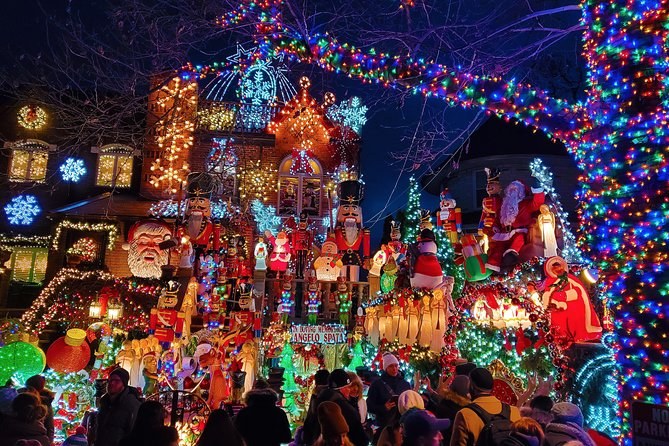
Nothing about this evening is complicated. You walk along a few residential streets in Brooklyn, in the cold, looking at the fronts of about eighty houses that their owners have decorated far past the point of reason. It is free, there is no gate and there is no ticket. What takes planning is getting there, staying warm and picking a night when the pavement is not three deep.
It costs nothing. The lights are on private houses along public streets, so you can walk them on any evening in the season without paying anyone. Nobody collects at a barrier, because there is no barrier, and none of the households asks for money to look.
What you can spend money on is optional and small. Some families run a donation box for a charity. Several sell hot chocolate, snacks and printed shirts from their driveways and front gardens, and food trucks work the corners on the busy nights. Bring twenty dollars in cash and you will not need more.
The other thing you can pay for is getting there and back, which is what a best Dyker Heights Christmas Lights tour is. That is a transport decision rather than an admission one, and it is worth taking on its own terms — see how to reach the neighbourhood.
Around dusk. In a New York December that means roughly half past four to five o'clock, and one resident interviewed about it described the timers going on "at 5, 5:30, when it's dark". Most displays are off by about ten at night. Some run much later, and one resident puts his own past one in the morning.
Nobody publishes a schedule, and it would be dishonest to print one. These are eighty separate households on domestic timers, making their own decision each night. The pattern holds — on at dusk, off around ten — and the exceptions are individual.
An hour covers it properly. That is not a coincidence: almost every guided trip allocates exactly one hour on the ground, because an hour at a walking pace with stops is what the core blocks take. Half an hour is enough for the two brightest streets if you are short of time.
Beyond ninety minutes it is usually the cold making the decision rather than the lights. The route page lays out a loop you can shorten or lengthen, and what the walking involves covers the ground itself.
Warmer than you think. You are standing still outdoors after dark for an hour, and standing still is colder than walking — it is the single most repeated piece of advice in the traveller reviews on every one of these tours. One reviewer describes a cold snap with temperatures feeling like single digits Fahrenheit.
What matters most: a hat and gloves, because your hands come out for
the camera.
What people forget: proper shoes. The pavements are uneven and the blocks
run gently uphill.
What helps: layers you can open on a heated coach and close on the
street.
What to skip: anything you have to carry. There is nowhere to put a bag
down.
Hot chocolate is easy to find. Residents sell it from garages and driveways for a few dollars, ice-cream vans park on the corners running snow machines, and food trucks work the busier junctions. All of it is cash.
Toilets are the gap. This is a residential neighbourhood and not a venue, so there are none on the display streets at all. Several of the coaches carry a restroom on board and one stops for a break on the way out, which is genuinely worth checking on the listing before you book. Go before you leave Midtown.
Very little, and all of it reasonable. Brooklyn Community Board 10's district manager, Josephine Beckmann, put it plainly in 2025: "We do ask that everyone is mindful that it is a residential community." More than a hundred thousand people a year walk past somebody's front door here.
In practice that means staying on the pavement rather than the path, keeping the noise down after nine, photographing the display rather than the windows, and taking your rubbish with you. The city adds extra bins and traffic control for the season, which tells you how much of both is needed. The families doing this have mostly been doing it for decades, and they are doing it for you.
Eleven guided trips leave Midtown for these blocks, from $45 a seat to a private car for six. Compare what each one covers before you decide.
Around dusk, which in a New York December means roughly half past four to five o'clock. The displays are on domestic timers and most go off around ten at night, though some run later. Nobody publishes a schedule, because it is eighty separate households making their own decision.
A weekday evening between about six and eight, in the second or third week of December. Weekends in mid-December between five and nine are the busiest hours of the season by a distance. The first week is the quietest and also the least reliable, because some houses are still going up.
About an hour on foot, on every coach tour, because buses are not allowed into the display streets. The blocks are gently uphill — the neighbourhood sits on a hill that rises to about 110 feet — and there is nowhere to sit down. If that is a problem, a private car can stay in the streets with you inside it.
Yes, and it is one of the few December evenings in New York built for them. The practical limits are the hour outdoors in the cold and the lack of anywhere to change or feed a baby. Pushchairs are fine on the pavements and several operators list stroller access explicitly.
The streets are public pavements and two listings state that their vehicle and the surfaces are wheelchair accessible. Most of the coaches state the opposite, and the pavements are crowded and uneven on a busy night. A private vehicle is the straightforward answer if walking is difficult.
Cold enough that it is the single most common piece of advice in the traveller reviews. You are standing still outdoors for an hour after dark in a New York December, which feels considerably colder than walking. Hat, gloves and proper shoes, and take the hot chocolate when you see it.
There are none on the display streets — it is a residential neighbourhood, not a venue. Several of the coaches have a restroom on board and one stops for a break on the way out, which is worth checking on the listing before you book. Plan on going before you leave Midtown.
On the street, with difficulty. Parking is residential, it fills early on the busy evenings, and the through streets carry heavy traffic from five o'clock onwards. Getting there without a car is covered in full on the getting there page.
Once you know what the evening looks like, the choice is how you get to it. Compare every departure on Dyker Heights Christmas Lights Tours, or read which blocks to walk first.
From $63 per person
From $75 per person