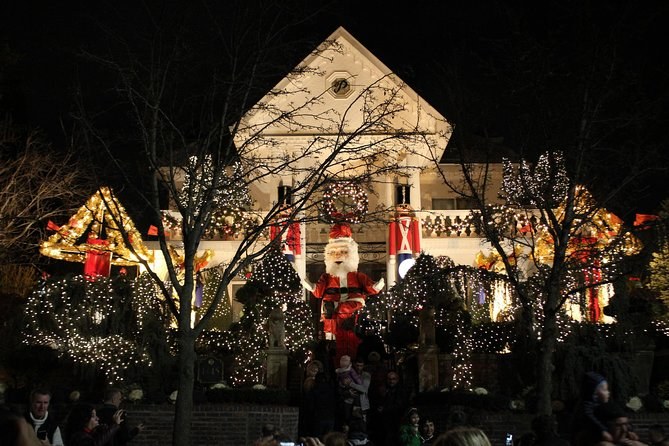
Seeing the Dyker Heights Christmas Lights Without a Tour
Short answer. You can absolutely do this yourself, and for two people staying in Manhattan it is the cheapest answer by a distance: two subway fares each way and about three hours door to door. What you give up is somebody who knows which four blocks are worth the hour, and a warm seat for the journey home.
Said plainly, on a site that sells tours: every fare here buys transport, the lights themselves are free, and nothing stops you walking up. Here is exactly what doing it alone involves, and the two situations where it is the better choice.
Is there anything you cannot do without a tour?
No. There is no gate, no ticket, no timed entry and no restriction of any kind. The display is on private houses along public streets and you may walk them on any evening of the season for nothing.
That is unusual, and it is worth stating plainly on a site that sells tours. What a guided evening buys is transport and judgement, not access.
How do you actually get there?
There is no subway station in Dyker Heights. The D stops at 79th Street and the R at 86th, both on the neighbourhood's edges, and each leaves ten to fifteen minutes on foot. The walk in is uphill; the walk out is not.
From Times Square allow forty-five to fifty-five minutes on the train. Eight bus routes also serve the area and the B1 along 86th Street is the useful one. Getting there has both walks in detail.
What does it cost to do it yourself?
Subway fares are approximate. The gap on price is large at two people and much smaller at six.
| On your own | Coach seat | Private car | |
|---|---|---|---|
| Two people | About $12 in fares | $90–$190 | $399 |
| Four people | About $23 | $180–$380 | $399 |
| Time, door to door | About 3 hours | 3.5–4 hours | 3.5 hours |
| Walking | The loop, plus 25–30 min to stations | About 1 hour | Optional |
| Who picks the blocks | You do | A guide does | A driver does |
Which blocks should you walk?
84th Street between 11th and 12th Avenues first. That is where the tradition started in 1986 and where the biggest displays still are. Then north to 83rd and back west along it, which is nearly as good and consistently less crowded.
An hour covers both properly. If you have thirty minutes, do 84th and turn back. The route page has the loop written out with the turns, and the street-by-street post says what is on each one.
What time should you arrive?
Between six and eight in the evening. The displays come on around dusk, which in December means half past four to five, and most go off around ten. Six to eight is full dark with the whole thing lit and time in hand.
Weekday evenings are considerably quieter than weekends. The busiest hours of the entire season are Saturday and Sunday between five and nine in mid-December, which is precisely when most people go.
What do you actually give up?
Local judgement. A guide takes a group to the best two streets in the
first twenty minutes. Working that out yourself costs you some of the hour.
The journey home. A fifteen-minute walk to the station in the cold at nine
o'clock, with several thousand other people doing the same.
The second stop. Most coaches add a Manhattan skyline view from the
Brooklyn side, which is genuinely good and is not on your route.
The commentary. Some of it is the history of the neighbourhood, which is
better than you would guess.
Two things to take that a coach would have covered. Cash in small notes, because nothing on the blocks takes a card, and a plan for the return journey before you set off. What the evening involves has the rest of the kit list.
When is doing it yourself clearly better?
Two situations. If you are already staying in Brooklyn, the coach exists to solve a Midtown-hotel problem you do not have — the R or the D gets you there without crossing a river. And if you are on a tight budget with time to spare, two fares against $90 is not a close contest.
There is a third, softer case: people who enjoy working a city out. If that is you, this is a good neighbourhood to do it in.
When is it clearly worse?
With small children, because the station walk in the dark and cold turns a manageable evening into a long one. With anyone whose mobility is limited, because the walking is the whole problem and only a private car removes it. And on your first evening in New York, when the guide is worth the money.
It is also worse if your dates are tight. A Dyker Heights walking tour takes care of the whole thing in a fixed window; doing it yourself is a variable one.
Is it safe to walk there after dark?
Yes, and it is busy. One traveller notes a heavy police presence during the season, and the city adds traffic control and extra bins because of the numbers. You are on residential streets with a great many other visitors on them.
Ordinary city sense applies for the walk to and from the station, which is quieter than the display blocks. Go with someone if that matters to you.
What about driving?
Possible on a quiet weeknight and a bad idea on a December Saturday. The streets are residential, the spaces belong to residents, and the through roads carry heavy traffic from five o'clock. Park further out than feels necessary and walk the last blocks.
The parking problem is a large part of why the coaches exist and why so many people who try it once take a tour the second time.
What do you need to bring if you go alone?
- Cash in small notes. The driveway hot chocolate and the food trucks take nothing else, and there is nowhere on the route to draw money.
- A hat and gloves. The single most repeated piece of advice in the traveller reviews, on every operator.
- Shoes with grip. The pavements are uneven and can be icy after rain.
- A charged phone. It is your map, your camera and your way home, and cold drains batteries fast.
- A plan for the return. Decide which station before you set off rather than at nine o’clock in the cold.
How long should you allow, door to door?
About three hours from Midtown. Roughly fifty minutes on the train each way, ten to fifteen minutes walking at each end, and an hour on the blocks. Add the waiting and it is close enough to the length of a coach tour to surprise people.
That matters because the fare is often described as buying time. It does not, really. It buys the navigation, a warm seat and somebody who knows the streets.
What do you miss by not having a guide?
The history, mostly, and it is better than you would expect. That the whole street began in 1986 with one woman decorating her house in memory of her mother. That there is a Queen Anne of 1899 on the National Register standing in the middle of the brightest block. That the biggest displays are installed by professional firms for thousands of dollars a season.
All of it is on the history page, and reading it beforehand recovers most of what a guide would have told you. What it does not recover is somebody answering the question you actually have while standing in front of the house.
The honest summary
If you are two people in Manhattan on a budget, take the subway and read the route page. If you are four or more, or anyone would rather not walk, or it is your one Christmas evening in New York, the fare buys something real. Both are defensible and neither is the answer for everybody.
Frequently asked questions
Do you need a ticket to see the Dyker Heights Christmas Lights?
No. The display is on residential streets, it is free, and there is no gate, no barrier and nothing to buy. What you pay for here is transport and a guide to get you there and back from Manhattan, which is a separate thing from admission.
How do I get there by subway?
There is no station in Dyker Heights, so every route ends in a walk. The D train to 79th Street and the R train to 86th Street are the two usual options and each leaves 10 to 15 minutes on foot at the far end. From Times Square, allow 45 to 55 minutes on the train before that walk.
Is the display free to walk around?
Yes, entirely. The lights are put up by residents on their own houses and the streets are public, so you can walk them any evening in the season at no cost. The route page sets out which blocks to walk and in what order.
Where can I park?
On the street, with difficulty. Parking is residential, it fills early on the busy evenings, and the through streets carry heavy traffic from five o'clock onwards. Getting there without a car is covered in full on the getting there page.
When is the best time to visit?
A weekday evening between about six and eight, in the second or third week of December. Weekends in mid-December between five and nine are the busiest hours of the season by a distance. The first week is the quietest and also the least reliable, because some houses are still going up.
How long should I spend there?
An hour covers the main blocks at a walking pace with time to stop, which is why almost every tour allocates exactly that. Half an hour is enough for the two brightest streets if you are short of time. Longer than 90 minutes is usually the cold rather than the lights making the decision.
Every departure this guide mentions, with fares and hours side by side, is on Dyker Heights Christmas Lights Tours.
If you decide the fare is worth it after all
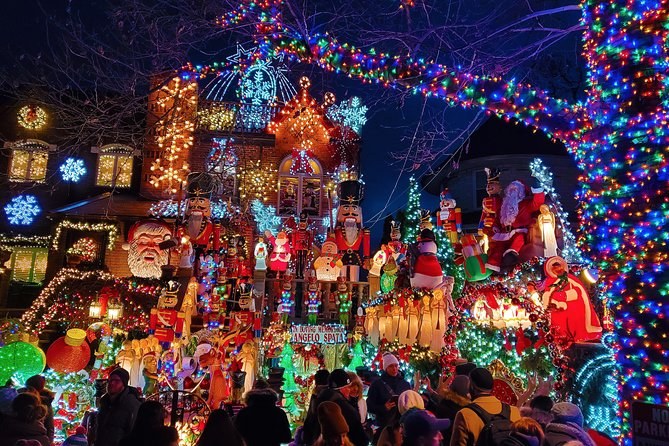
Dyker Heights Christmas Lights Guided Tour
Restroom on boardLicensed guideHeated vehicle
From $63 per person
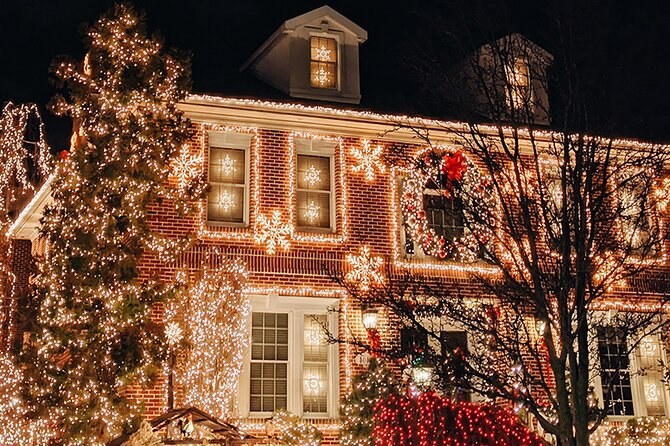
Christmas Lights Tour in New York City Dyker Heights
Portuguese & SpanishHeated vehicleWiFi on board
From $45 per person